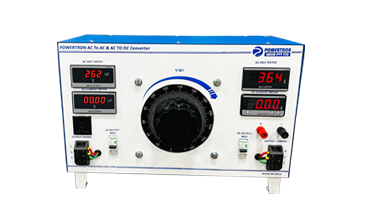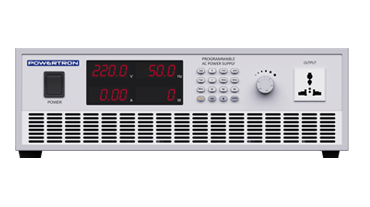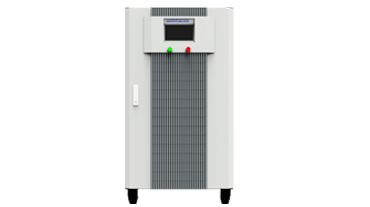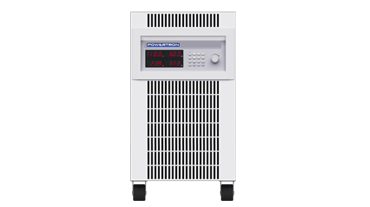

Variac Controlled AC Power Supply Manufacturer & Exporter in India
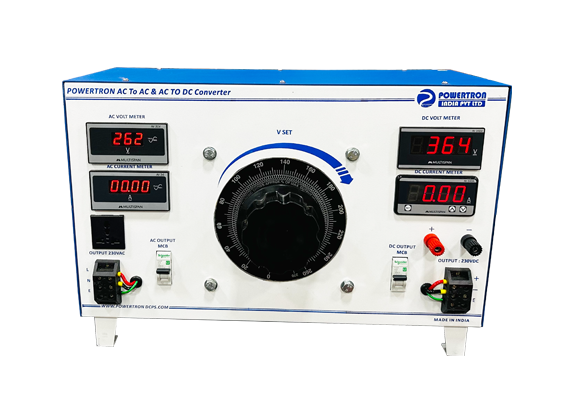





Technical Specifications — Variac Controlled AC Power Supply
| Parameter | Specification | What It Means For You |
|---|---|---|
| Input Voltage | 230VAC single phase / 415VAC three phase, or customised | Connects to standard Indian bench or panel supply without a step-down |
| Output Voltage | Continuously variable, 0-100% of input (higher on boost models) | True stepless control from zero to full without switching steps |
| Current Capacity | 10 / 20 / 30 / 50 / 100 A, higher ratings to order | One product family covers bench testing through panel-level loads |
| Output Waveform | Undistorted sine wave, no phase-angle chopping | Motors, transformers and inductive loads behave as they would on mains |
| Control | Rotary dial with carbon brush on exposed winding | Fine manual resolution with immediate tactile feedback |
| Display | Output voltage and current, or customised | Applied condition read directly without external instrumentation |
| Protection | Overload and short-circuit protection on advanced models | DUT failure trips the supply instead of damaging the winding |
| Construction | Copper-wound autotransformer, low-noise operation | Continuous shift duty in workshop ambient conditions |
| Output Termination | Closed-type terminal, or customised socket outlet | Matches the existing bench wiring practice |
| Mounting | Table top, or customised panel / trolley format | Fits the test cell without mechanical rework |
| On-Off Control | Input-side switching | Supply is isolated at source, not downstream of the variac |
Available Models — Variac Controlled AC Power Supply
| Model | Input Voltage | Current Rating | Output Voltage |
|---|---|---|---|
| PIPL-10VAC-1PH | 230VAC 1-Ph | 10 A | 0-270VAC |
| PIPL-20VAC-1PH | 230VAC 1-Ph | 20 A | 0-270VAC |
| PIPL-30VAC-1PH | 230VAC 1-Ph | 30 A | 0-270VAC |
| PIPL-50VAC-1PH | 230VAC 1-Ph | 50 A | 0-270VAC |
| PIPL-100VAC-1PH | 230VAC 1-Ph | 100 A | 0-270VAC |
| 3-Phase variants | 415VAC 3-Ph | On request | 0-470VAC |
WE ALSO PROVIDE CUSTOMISED SOLUTIONS |
|||
Which Variac Capacity Do You Need?
| Capacity | Approx. Load at 230V | Typical Use |
|---|---|---|
| 10 A | Up to ~2.3 kVA | Bench testing of small appliances, electronic assemblies, single components |
| 20 A | Up to ~4.6 kVA | Fractional-HP motor testing, control panel commissioning, QA inspection |
| 30 A | Up to ~6.9 kVA | Small motor starting studies, heater and element testing, panel burn-in |
| 50 A | Up to ~11.5 kVA | Production test benches, transformer testing, multi-station QA lines |
| 100 A | Up to ~23 kVA | Heavy motor testing, industrial panel validation, high-current bench work |
| Customised | Above 23 kVA | Three-phase installations, dedicated test cells, non-standard input voltages |
How a Variac Controlled AC Power Supply Works
A variac — properly a variable autotransformer — is a single continuous winding on a toroidal core, with a short arc of that winding left bare so a carbon brush can ride directly on the copper. Mains is applied across the full winding; the output is taken between one end of the winding and the brush. Rotating the dial moves the brush along the exposed track, changing how many turns sit between the two output terminals, and therefore changing the output voltage.
The critical consequence is what does not happen. Because the output is a transformer tap that simply moves, the supply never chops the waveform. Compare that with a phase-angle or thyristor-based voltage controller, which reduces the RMS output by switching off part of each half-cycle and hands the load a distorted waveform full of harmonics. A motor, a transformer or an inductive test article behaves very differently on those two supplies — which is why variacs remain standard equipment on motor and appliance test benches even where programmable sources are available.
Because it is an autotransformer rather than an isolating transformer, the primary and secondary share the winding, so losses and heat rise are lower and efficiency is high — but there is no galvanic isolation between input and output. Where isolation is required by the test procedure, an isolation transformer is fitted ahead of the variac. Output current capacity is set by the winding cross-section and brush contact area, which is why the range is specified in amps rather than kVA.
Applications of Variac Controlled AC Power Supplies
A variac is chosen when the requirement is clean, stepless voltage variation under manual operator control — not when the requirement is programmed sequencing or frequency variation. The mapping below reflects where that distinction actually matters on the shop floor.
| Industry | Application | Why a Variac Rather Than a Programmable Source |
|---|---|---|
| R&D Laboratories | Bench-level voltage sensitivity studies on prototypes | Immediate tactile adjustment while watching the DUT respond |
| Aerospace & Defence Electronics | Sub-assembly power-up and functional checks | Slow controlled energisation of expensive units without programming |
| Automation & Panel Integration | Control panel commissioning and pre-dispatch inspection | One operator, one dial, no test software or configuration |
| Automotive Component Testing | Component behaviour across a supply voltage range | Continuous sweep rather than discrete programmed steps |
| Telecom Equipment Testing | Brown-out and low-voltage tolerance checks | Clean sine wave preserved at reduced voltage |
| Oil & Gas Equipment Testing | Field instrument and actuator functional testing | Rugged construction suited to non-laboratory environments |
| Motor & Pump Manufacturing | Soft energisation and starting current observation | Undistorted waveform gives true motor behaviour |
| Electrical Contracting | Site panel testing and insulation pre-checks | Portable, simple, no dependency on control infrastructure |
Variac vs Programmable AC Source vs Servo Stabilizer
Buyers frequently confuse these three products because all of them "change the AC voltage". They solve different problems, and the table below is the fastest way to place an enquiry in the right category.
| Criteria | Variac Controlled Supply | Programmable AC Source | Servo Voltage Stabilizer |
|---|---|---|---|
| Purpose | Manual stepless voltage variation for testing | Programmed voltage, frequency and waveform simulation | Automatic correction of incoming mains variation |
| Control | Rotary dial, operator-driven | Digital set point and stored sequences | Automatic closed-loop, no operator input |
| Frequency control | None — output follows mains | Programmable | None |
| Waveform | Pure sine, never chopped | Synthesised, THD typically under 1% | Pure sine, follows input |
| Repeatability | Operator-dependent | Exact and logged | Not applicable |
| Automation | Not available | RS232 / RS485 / Ethernet | Not applicable |
| Typical cost position | Lowest | Highest | Mid |
| Best fit | Test benches, QA, commissioning | R&D, certification, export testing | Protecting production equipment |
How to Select a Variac Controlled AC Power Supply
- Maximum load current, not kVA — variac capacity is set by winding and brush current rating, so quote the actual amps the load draws including starting inrush.
- Input supply available — 230VAC single phase or 415VAC three phase, and whether a neutral is present at the bench.
- Output voltage range required — standard 0-100% of input, or a boost-wound unit if the test procedure needs above-mains voltage.
- Isolation requirement — a variac is an autotransformer and provides no galvanic isolation. If the procedure requires it, an isolation transformer must be fitted ahead of the unit.
- Metering needed — voltage only, voltage and current, or additional power and power-factor display.
- Protection level — basic input MCB, or overload and short-circuit protection for a bench where DUT failure is routine.
- Duty cycle — occasional bench use or continuous shift operation, which changes the thermal design.
- Mounting and termination — table-top, panel-mounted or trolley, with closed terminals or socket outlets.
Custom Variac Controlled AC Power Supply Builds
Standard capacities cover 10A through 100A, but the majority of installations involve at least one non-standard element. POWERTRON builds to specification: higher current ratings, three-phase ganged variac assemblies with mechanically coupled dials, boost-wound units delivering above-mains output, motorised variacs with remote or push-button drive, and non-standard input voltages for export installations.
Enclosure and metering are equally configurable — panel-mount, trolley-mounted or cabinet format, digital or analogue metering, additional kW and power-factor display, socket outlet arrangements matched to the customer's existing plug standard, and integrated isolation transformers where the test procedure demands galvanic separation. Share the load current, input supply, output range, metering requirement and mounting constraint, and the application engineering team returns a proposed configuration with an indicative timeline. Design, winding, assembly and testing all happen in-house at Thane, so custom builds carry no import lead-time penalty.
Manufacturing, Quality and Export Capability
POWERTRON INDIA PVT. LTD. designs and manufactures its complete AC power supply range at Plot No. A-426/427, Road No. 28, Wagle Estate MIDC, Thane West 400604, Maharashtra. Design, magnetics winding, PCB assembly, enclosure fabrication and final load testing are all carried out in-house, which is what allows both short lead times and genuine engineering support after the sale rather than component-level replacement only.
Every unit is tested on load across its full output envelope before dispatch, with the test record supplied against the serial number. The company holds ISO, CE and BIS certifications, is MSME registered and GeM listed, and manufactures under the Make in India framework — making POWERTRON a practical import substitute for organisations currently sourcing AC test sources from overseas. Domestic sales and service offices operate in Delhi, Pune, Hyderabad, Bangalore and Tamil Nadu, with international offices in Dubai, Singapore and Malaysia supporting export customers across the Middle East, Southeast Asia, Africa and Europe.
Frequently Asked Questions — Variac Controlled AC Power Supply
It is an AC supply built around a variable autotransformer, where output voltage is adjusted continuously by moving a carbon brush along an exposed section of the winding. This gives genuinely stepless voltage variation from near zero to full input voltage, with the output waveform left as an undistorted sine wave.
No. A variac is an autotransformer, so input and output share a common winding and there is no galvanic isolation. Where the test procedure requires isolation, an isolation transformer is fitted ahead of the variac. POWERTRON supplies both, and can deliver them as an integrated assembly.
Standard units are built in 10A, 20A, 30A, 50A and 100A capacities, with higher ratings available to order. Because a variac is rated by winding and brush current rather than by kVA, specify the actual load current including starting inrush rather than an assumed power figure.
Yes, on boost-wound models. A standard unit varies from zero to input voltage; a boost-wound variac carries additional turns that allow output above mains, which is required where the test standard calls for over-voltage conditions. Specify the required maximum at enquiry.
A dimmer or thyristor controller reduces RMS voltage by switching off part of each half-cycle, which distorts the waveform and injects harmonics. A variac moves a transformer tap, so the waveform is never chopped. Motors, transformers and inductive loads behave very differently on the two, which is why variacs remain standard on motor test benches.
No. A stabilizer automatically corrects incoming mains variation to hold a fixed output and protect equipment. A variac deliberately varies the output under operator control so equipment can be tested across a voltage range. POWERTRON manufactures both.
Yes, as a custom build. Motorised variacs with push-button or remote drive are supplied where the operator cannot be at the panel, or where a slow controlled ramp is required. Standard catalogue units are manually operated by rotary dial.
Advanced models include overload and short-circuit protection so that a failing test article trips the supply rather than damaging the winding. Basic units are protected at the input side. Specify the protection level required, particularly for QA benches where DUT failure is a routine event.
Yes. Three-phase units use ganged variac assemblies with mechanically coupled dials so all three phases track together, fed from a 415VAC three-phase input. These are built to the required current rating and are quoted on application.
Need a Variac Controlled AC Power Supply?
Request a quotation for a Variac Controlled AC Power Supply. Send us your load current, input supply, required output range, metering and mounting format. Our team will confirm the correct capacity and provide a quote for standard or custom builds, including motorised and three-phase variac assemblies.