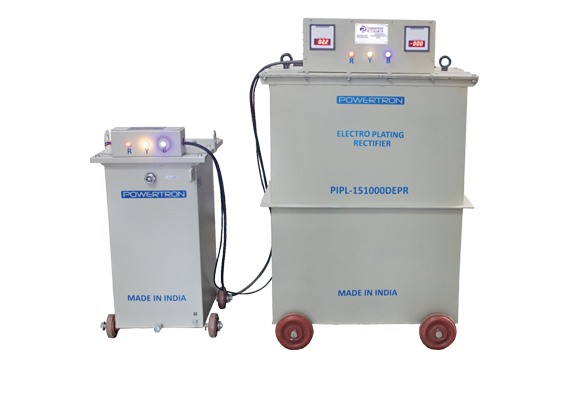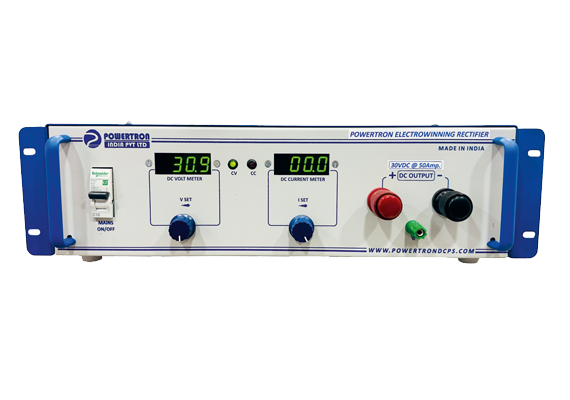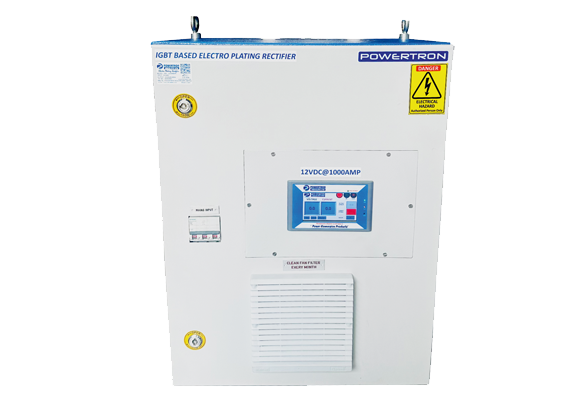

Thyristor Controlled Plating Rectifier Manufacturers & Exporters
Powertron's Thyristor Controlled Plating Rectifier uses modular SCR-based power stages to deliver reliable, regulated DC for heavy-duty electroplating and anodizing lines. Output voltage runs from 0–12VDC to 0–100VDC, with current customised and active current sharing across modules for scalable, high-current applications. This page covers features, specification, model options and how thyristor control compares to MOSFET, IGBT and diode alternatives.
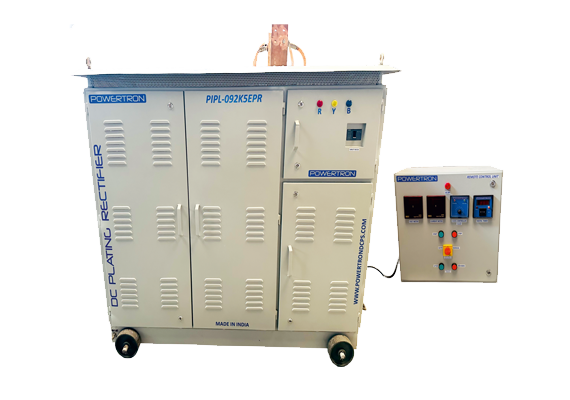





Technical Specification
| Parameter | Specification | What It Means For You |
|---|---|---|
| Output Voltage | 0–12VDC to 0–100VDC (standard bands) | One modular platform spans small-parts plating through higher-voltage processes. |
| Output Current | Customisable, modular scaling | Current capacity is added by paralleling modules rather than redesigning the unit. |
| Current Sharing | Active, across modules | Even load distribution as more modules are added for higher current. |
| Control | Independent voltage & current, manual current limit | Direct, predictable control for chemistries with narrow process windows. |
| Construction | Modular, SCR-based power stages | Field-proven technology for heavy industrial duty; individual modules can be serviced without replacing the whole unit. |
| Duty Rating | Continuous, endurance-rated | Sized for sustained production-line operation rather than intermittent duty. |
Model / Variant Table
| DC Output | DC Current |
|---|---|
| 0–12VDC | Customisable to load |
| 0–18VDC | Customisable to load |
| 0–24VDC | Customisable to load |
| 0–60VDC | Customisable to load |
| 0–100VDC | Customisable to load |
Range Quick-Selection Table
| Output Range Needed | Recommended Model |
|---|---|
| 0–24VDC, moderate current | General electroplating, metal finishing lines |
| 0–24 to 0–60VDC, modular scaling | Automotive and industrial plating requiring higher current |
| 0–60 to 0–100VDC | Heavy-duty anodizing and electrochemical processes |
How It Works
Thyristor (SCR) control regulates DC output by phase-controlling the conduction angle of each half-cycle of the AC input, a technology proven over decades in heavy industrial rectification. Powertron's Thyristor Controlled Plating Rectifier builds this into a modular architecture: individual thyristor power modules are paralleled with active current sharing to reach the required output current, so capacity is scaled by adding modules rather than by redesigning the transformer and control stage.
Voltage and current are set and held independently, and the manual current limit option lets an operator constrain output directly for a given plating chemistry. Because the design is modular, a single module fault can typically be isolated and serviced without taking the entire rectifier — and the production line it feeds — out of service, which is a key reason thyristor rectifiers remain the standard choice for heavy-duty, continuous plating operations where uptime matters as much as current rating.
Applications by Industry
| Industry | Application | Load / Duty Character | Recommended Configuration |
|---|---|---|---|
| Metal Finishing | High-volume electroplating baths | Continuous, heavy duty | 0–24 to 0–60VDC, modular current |
| Automotive Components | Chrome, nickel, zinc plating lines | Continuous production | 0–24 to 0–60VDC |
| Aerospace & Defence | Precision and protective plating | Continuous, high-reliability | 0–24 to 0–100VDC |
| Semiconductor | Electrochemical processing steps | Continuous | Modular, precise current control |
| Renewable Energy | Component plating and finishing | Batch/continuous | 0–24 to 0–60VDC |
| Power Generation | Busbar and component plating | Continuous, heavy duty | 0–60 to 0–100VDC, high current |
Thyristor vs. IGBT Controlled Plating Rectifier
| Criteria | Thyristor Controlled | IGBT Controlled |
|---|---|---|
| Technology | SCR phase control, modular | High-frequency IGBT switching |
| Field-proven heavy duty history | Decades of industrial use | Newer, growing adoption in heavy duty |
| Module serviceability | Individual modules field-serviceable | Modules field-serviceable, higher component density |
| Response speed | Tied to AC line cycle | Faster electronic response |
| Scalability | Modular, add units for more current | Modular, add units for more current |
| Best fit | Heavy industrial duty, proven reliability priority | High-power lines needing fastest response and tightest V/I precision |
| Relative footprint per amp | Larger | More compact |
Manufacturing & Quality
Every Thyristor Controlled Plating Rectifier is built at Powertron India's own manufacturing facility in Wagle Estate, MIDC, Thane (Maharashtra), where design, winding, assembly, and testing are carried out in-house rather than outsourced. Units go through a documented quality process before dispatch, and Powertron holds ISO, CE, BIS, and GeM empanelment credentials, with manufacturing recognised under the Make in India and MSME programmes. Beyond Thane, Powertron supports customers through sales offices in Delhi, Pune, Hyderabad, Bengaluru and Tamil Nadu, and serves export markets through international sales offices in Dubai, Singapore and Malaysia. Post-installation, the same team that engineers the unit is available for commissioning support, spares, and after-sales service, so buyers are not left dealing with a reseller once the order ships.
FAQ
Thyristor control regulates DC output by phase-controlling the AC input; it's a long-proven, industrially rugged technology well suited to heavy, continuous plating duty.
0–12VDC up to 0–100VDC in standard bands, with current customised and scaled by adding modules.
Individual power modules can typically be isolated and serviced without taking the full rectifier, and the plating line it feeds, out of service.
Yes, independent voltage and current setting is standard, along with a manual current limit option.
Yes, current capacity scales by paralleling additional modules with active current sharing rather than by redesigning the unit.
Thyristor control is a longer-proven technology for heavy industrial duty; IGBT control offers faster electronic response and a more compact footprint per amp — see the comparison table above.
Standard rectifier protections apply, and the modular design limits the impact of a single module fault on the rest of the system.
Metal finishing, automotive, aerospace & defence, semiconductor, renewable energy and power generation, particularly at higher current levels.
Share your existing units' specifications and the team can recommend compatible or standardised modules.
Send your required output voltage and current to sales@powertrondcps.com or call the numbers listed above.
Need a Thyristor Controlled Electro-Plating Rectifier?
Request a quotation for a Thyristor Controlled Electro-Plating Rectifier. Send your required DC output voltage and current to sales@powertrondcps.com or call +91 8097707496 / +91 7208560460 — most plating rectifier quotations are returned once load and process details are confirmed.