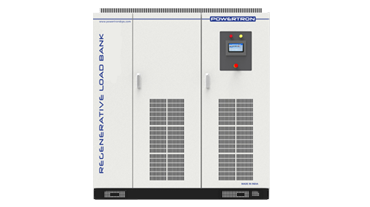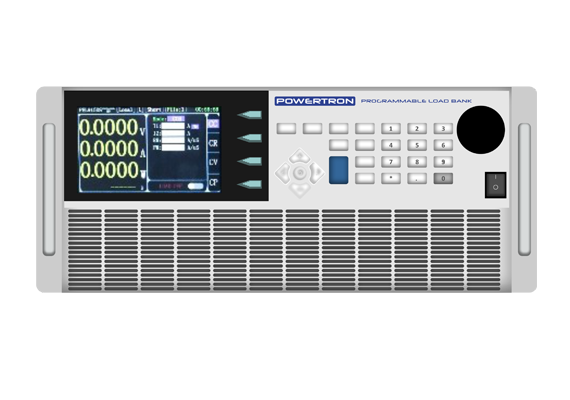

Resistive Load Bank Manufacturers & Exporters
POWERTRON manufactures resistive load bank systems in India for generator commissioning, UPS proving, battery discharge testing and DC system verification, built around punched Fechral grid resistor elements rated for a 375°C temperature rise. A resistive load bank is the simplest and most robust way to present a genuine, known load to a power source — no electronics in the load path, no failure modes that need firmware to diagnose, and no dependence on a grid connection to absorb the energy. That is precisely why it remains standard equipment for site commissioning and acceptance testing, where the priority is proving the source performs under real load rather than characterising it dynamically. Elements are supplied in standard punched grid box sizes from A1 through D6, in AC and DC configurations, with ratings and enclosures built to the installation. Manufactured in-house at Wagle Estate, Thane.
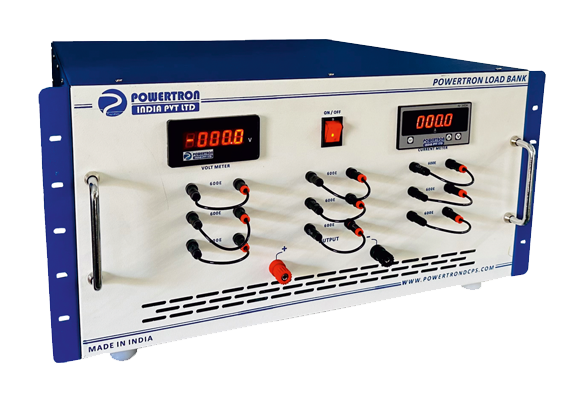
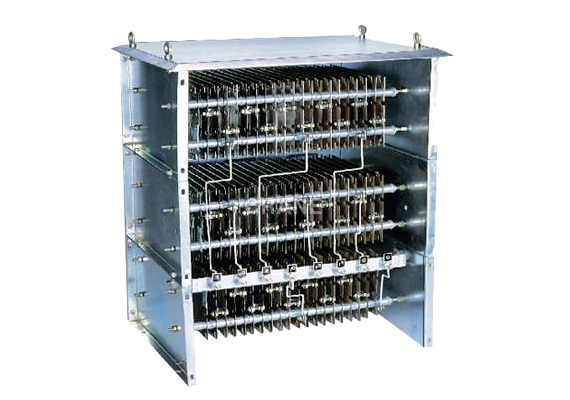







Technical Specifications — Resistive Load Bank
| Parameter | Specification | What It Means For You |
|---|---|---|
| Element Type | Punched Fechral grid resistors | High-temperature alloy tolerant of repeated thermal cycling |
| Temperature Rise Rating | 375°C | Current ratings are stated against a defined thermal condition |
| Resistance Range | 0.01 to 2.5 ohms per element | Banks configured to the actual source voltage and current |
| Current Rating | Duty-factor dependent — see the 25/40/60/100% ED chart | Correct sizing for intermittent or continuous duty |
| Grid Box Sizes | A1, A2, B1, B2, C1-C6, D1-D6 | Dimensional planning possible before manufacture |
| Box Dimensions | 430mm to 880mm width, 280mm to 1680mm height | Layout confirmed against available floor or enclosure space |
| Configuration | AC and DC | Generator and UPS testing, or battery and rectifier testing |
| Power Rating | Built to requirement | Sized to the source being tested, not to a catalogue step |
| Control | Step switching, contactor or manual | Matched to whether the bank is operated on site or in a test cell |
| Cooling | Forced air or natural convection by rating | Selected against duty and installation environment |
| Enclosure | Built to installation — indoor, outdoor, trailer or containerised | Site-appropriate rather than a fixed format |
Resistance Boxes
| Dimensions Details of Punched Fechra Resistance Boxes | ||||||||
|---|---|---|---|---|---|---|---|---|
| Unit Size | A | a | b | Unit Size | A | a | b | H |
| A1 | 430 | 380 | 360 | B1 | 580 | 530 | 510 | 280 |
| A2 | 430 | 380 | 360 | B2 | 580 | 530 | 510 | 560 |
| C1 | 730 | 680 | 650 | D1 | 880 | 830 | 805 | 280 |
| C2 | 730 | 680 | 650 | D2 | 880 | 830 | 805 | 560 |
| C3 | 730 | 680 | 650 | D3 | 880 | 830 | 805 | 840 |
| C4 | 730 | 680 | 650 | D4 | 880 | 830 | 805 | 1120 |
| C5 | 730 | 680 | 650 | D5 | 880 | 830 | 805 | 1400 |
| C6 | 730 | 680 | 650 | D6 | 880 | 830 | 805 | 1680 |
Resistance Boxes
| Rated Values (Ohms) | Current Rating for Various Duty Factors (AMPS) | |||
|---|---|---|---|---|
| 25% ED | 40% ED | 60% ED | 100% ED | |
| 0.01 | 666 | 488 | 420 | 352 |
| 0.015 | 550 | 404 | 350 | 290 |
| 0.022 | 450 | 330 | 286 | 238 |
| 0.032 | 374 | 276 | 230 | 198 |
| 0.046 | 314 | 228 | 196 | 166 |
| 0.068 | 256 | 190 | 166 | 136 |
| 0.1 | 212 | 156 | 132 | 112 |
| 0.15 | 174 | 136 | 110 | 92 |
| 0.22 | 144 | 108 | 90 | 76 |
| 0.3 | 120 | 96 | 76 | 66 |
| 0.46 | 98 | 72 | 62 | 52 |
| 0.72 | 78 | 60 | 50 | 42 |
| 1 | 64 | 50 | 42 | 38 |
| 1.5 | 56 | 40 | 36 | 30 |
| 2.5 | 40 | 30 | 24 | 20 |
| Duty Factor | Meaning | When It Applies |
|---|---|---|
| 25% ED | Energised one quarter of the time | Short-burst step testing, brief acceptance checks, intermittent proving |
| 40% ED | Energised roughly two fifths of the time | Routine commissioning sequences with cooling intervals between steps |
| 60% ED | Energised roughly three fifths of the time | Extended commissioning, multi-step generator acceptance runs |
| 100% ED | Continuously energised | Full-duration load soaking, endurance testing, continuous burn-in |
| Sizing consequence | Current capacity falls as duty rises | A 0.1 ohm element carries 212A at 25% ED but only 112A continuously — nearly half. Size against the longest continuous period the test actually requires. |
How a Regenerative Load Bank Works
A resistive load bank is exactly what its name says — a bank of precisely known resistances that can be connected to a power source in defined combinations to draw a defined load. There is no conversion stage and no electronics in the load path. The source sees a real resistance, current flows according to Ohm’s law, and the energy becomes heat in the elements.
The element is where the engineering sits. Punched grid resistors are made from sheet alloy stamped into a serpentine pattern, which gives a large surface area for heat rejection in a compact envelope and allows the resistance value to be set precisely by the geometry of the punch. Fechral — an iron-chromium-aluminium alloy — is used because it holds its resistance value through repeated heating to several hundred degrees without the drift that would gradually corrupt test accuracy.
Current capacity is a thermal question rather than an electrical one. An element carrying current heats up; how much current it can carry depends on how long it stays energised and how effectively the heat is removed. That is why the rating chart on this page gives four different current figures for the same resistance value at 25%, 40%, 60% and 100% duty factor. Elements are grouped into standardised grid boxes, and boxes are combined and switched — manually, by contactor, or in programmed steps — to build the load profile the test procedure requires.
Applications of Regenerative Load Banks
Regenerative load banks are justified wherever test duty is long, repetitive or high-power — the payback comes from hours of operation, not from the purchase. Short, occasional commissioning tests are usually better served by a resistive bank.
| Industry | Application | Why Resistive Rather Than Regenerative |
|---|---|---|
| Power Transmission | Substation DC system and battery discharge verification | No grid export permission needed at a live substation |
| Telecom & Data Centre | UPS, generator and rectifier plant acceptance testing | Simple, robust, no interaction with critical site supply |
| Railway & Transportation | Trackside and depot standby power commissioning | Field-deployable with no grid connection dependency |
| Aerospace | Ground power unit and generator proving | Predictable load with no control electronics to fail |
| Medical Equipment | Hospital standby generator statutory testing | Straightforward periodic compliance testing |
| Solar & Wind | Site commissioning where export is not yet permitted | Testing possible before grid connection is energised |
| Electronics Manufacturing | Power supply burn-in and endurance soaking | Continuous duty at low capital cost |
| Petrochemical | Emergency generator and DC backup commissioning | Hazardous-area installations where simplicity is a safety asset |
Resistive vs Regenerative vs Programmable Load Bank
| Criteria | Resistive Load Bank | Regenerative Load Bank | Programmable Load Bank |
|---|---|---|---|
| Energy handling | Dissipated as heat | Returned to the grid | Dissipated as heat |
| Capital cost | Lowest | Highest | Moderate |
| Running cost | Highest | Lowest over long duty | Moderate |
| Grid dependency | None — works anywhere | Requires a grid connection to export into | None |
| Export permission | Not required | May be required by the licensee | Not required |
| Complexity | No electronics in the load path | Four-quadrant converter and digital control | Digital electronic load |
| Control modes | Fixed resistance steps | CR, CV, CC, CP | CV, CC, CR, CP |
| Field deployability | Highest — trailer and container builds | Fixed installation | Bench and rack |
| Best fit | Site commissioning, acceptance, statutory testing | Long-duration high-power laboratory testing | Component and bench-level electronic loading |
Manufacturing, Quality and Export Capability
POWERTRON INDIA PVT. LTD. designs and manufactures its complete power conversion range at Plot No. A-426/427, Road No. 28, Wagle Estate MIDC, Thane West 400604, Maharashtra. Design, magnetics, PCB assembly, enclosure fabrication and full-load testing are all carried out in-house, which is what allows both short lead times and real engineering support after the sale rather than component-level replacement only.
Every unit is tested on load across its full operating envelope before dispatch, with the test record supplied against the serial number. The company holds ISO, CE and BIS certifications, is MSME registered and GeM listed, and manufactures under the Make in India framework — making POWERTRON a practical import substitute for organisations currently sourcing from overseas. Domestic sales and service offices operate in Delhi, Pune, Hyderabad, Bangalore and Tamil Nadu, with international offices in Dubai, Singapore and Malaysia supporting export customers across the Middle East, Southeast Asia, Africa and Europe.
Frequently Asked Questions — Resistive Load Bank
It presents a known, real load to a power source so the source can be proven to deliver its rated output. The most common uses are generator commissioning and acceptance testing, UPS proving, battery discharge verification and DC system testing at substations and data centres.
ED is duty factor — the proportion of time the elements are energised. The same resistance element carries substantially more current on intermittent duty than continuously. A 0.1 ohm element is rated at 212A at 25% ED but 112A at 100% ED, so sizing against the wrong duty factor nearly doubles the error.
Punched grid elements give a large heat-rejecting surface area in a compact envelope and allow the resistance to be set precisely by the geometry of the punch. Fechral holds its resistance value through repeated heating to several hundred degrees, so test accuracy does not drift over the life of the bank.
Resistive if the testing is occasional, site-based, or in a location with no grid connection to export into — commissioning and statutory testing typically fall here. Regenerative if testing is long-duration, high-power and repetitive, where recovering the energy pays back the higher capital cost.
Into the surrounding air. On an indoor installation the full test power appears as heat the building ventilation must remove, which is frequently the constraint that decides the installation location. Outdoor, trailer-mounted and containerised builds avoid the problem entirely.
Yes. The same construction serves both. AC configurations are used for generator and UPS acceptance testing; DC configurations for battery discharge, rectifier plant and substation DC system verification.
Yes. Elements are grouped into switchable banks, and the step resolution is set at design. Switching can be manual for simple acceptance work, contactor-based for repeatable sequences, or controller-driven with data logging where a test record is required.
Yes. Mobile builds for commissioning contractors and containerised builds for permanent yard installations are both supplied. State the installation environment at enquiry as it affects enclosure, cooling and element rating.
Source rating in kW or kVA, AC or DC, test voltage and current, the longest continuous energised period, required load step resolution, control arrangement, and the installation environment including ambient temperature.
Need a Resistive Load bank?
Request a quotation for a resistive load bank. Send your source rating, AC or DC, test voltage and current, duty cycle, required step resolution and installation environment to sales@powertrondcps.com, or call +91 8097707496 / +91 7208560460. Every resistive load bank is configured to the application.