

3 Phase Programmable AC Power Supply Manufacturer & Exporter in India
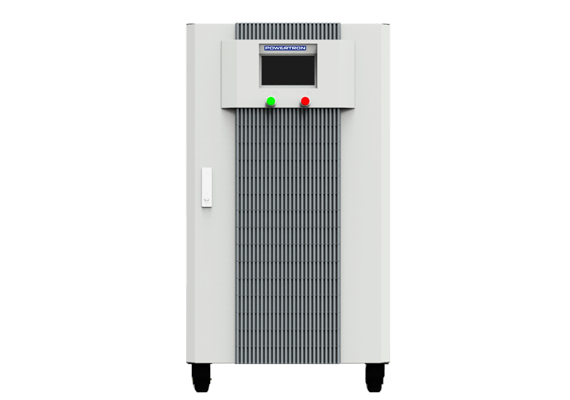





Technical Specifications - 3 Phase Programmable AC Power Supply
| Parameter | Specification | What It Means For You |
|---|---|---|
| Capacity Range | 15 kVA to 180 kVA; customised above | Component bench through to full machine-level test cells |
| Phase Voltage | Programmable 0-300V | Covers 208V, 220V, 230V and 240V phase-to-neutral systems |
| Line Voltage | Programmable 0-520V | Covers 380V, 400V, 415V and 480V line-to-line systems |
| Output Current | 45A to 544A (low range) / 22.5A to 272A (high range) | Source matched to the DUT operating point, not a single compromise |
| Power Stage | IGBT based | High efficiency, low distortion, fast response under stepping load |
| Frequency Control | Programmable | Destination-market and non-standard frequencies reproduced |
| Phase Angle Control | Programmable per phase | Unbalanced supply and phase-loss conditions created deliberately |
| Waveform | Programmable waveform generation | Distorted supply conditions reproduced for immunity testing |
| Protection | Short circuit and overload (SC/OL) | High-value three-phase DUT faults trip cleanly |
| Operator Interface | Numeric keypad quick setting | Direct set-point entry, reduced test cycle time |
| Remote Control | Remote interface and control supported | Runs unattended within an automated test sequence |
| Customisation | Capacities and configurations above the standard range | Test cells sized to the application rather than the catalogue |
Available Models — 3 Phase Programmable AC Power Supply
| Model | Voltage | Current (Low/High) | Power |
|---|---|---|---|
| PIPL-15KPAP-3PH | Phase voltage
0- 300V Line voltage 0-520V |
45A/22.5A | 15kVA |
| PIPL-30KPAP-3PH | 90A/45A | 30kVA | |
| PIPL-45KPAP-3PH | 136A/68A | 45kVA | |
| PIPL-60KPAP-3PH | 182A/91A | 60kVA | |
| PIPL-90KPAP-3PH | 272A/136A | 90kVA | |
| PIPL-120KPAP-3PH | 362A/181A | 120kVA | |
| PIPL-150KPAP-3PH | 454A/227A | 150kVA | |
| PIPL-180KPAP-3PH | 544A/272A | 180kVA | |
| WE ALSO PROVIDE CUSTOMIZED SOLUTION | |||
Which Capacity Do You Need?
| Capacity Band | Current (Low/High) | Typical Application |
|---|---|---|
| 15-30 kVA | 45A-90A / 22.5A-45A | Three-phase component testing, small motor and drive validation, panel testing |
| 45-60 kVA | 136A-182A / 68A-91A | Mid-size motor testing, industrial equipment qualification, appliance certification |
| 90-120 kVA | 272A-362A / 136A-181A | EV traction and charger validation, larger drive systems, renewable inverter testing |
| 150-180 kVA | 454A-544A / 227A-272A | Machine-level and vehicle-level test cells, railway sub-system qualification |
| Above 180 kVA | On application | Custom builds for dedicated test facilities and multi-station laboratories |
How a 3 Phase Programmable AC Power Supply Works?
A three-phase programmable AC source regenerates all three output phases rather than modifying the incoming supply. Mains is rectified and filtered to an internal DC bus, and that bus feeds three independently controlled IGBT inverter legs. A digital controller synthesises each phase waveform point by point, filters the switching frequency out, and holds each output at its programmed amplitude, frequency and phase relationship.
Independent control of the three legs is what separates a three-phase programmable source from three single-phase sources wired together. Because the controller sets the phase angle of each output individually, it can create conditions that a healthy grid never produces: a deliberate voltage imbalance across phases, a shifted phase angle, a single-phase sag while the other two hold, or a complete phase loss. Three-phase equipment qualification standards call for exactly these conditions, and they cannot be produced with a variac or with a transformer-based supply.
The IGBT power stage matters for dynamic behaviour. A motor starting, a drive stepping load, or an EV charger switching modes all present a fast current step. The switching speed of IGBTs, combined with a control loop correcting within each switching period, is what allows the source to hold its programmed voltage through that step rather than sagging and corrupting the test.
Each capacity is specified at two current ratings because output current is limited by the power stage, not by the transformer. Running at the low end of the voltage range allows roughly double the current of the high end at the same kVA — so a 15kVA unit delivers 45A at low range or 22.5A at high range, and the correct choice depends on the DUT operating point.
Applications of 3 Phase Programmable AC Power Supplies
Three-phase programmable sources are specified where the equipment under test is itself three-phase, or where the test standard requires supply conditions that a real grid connection cannot deliver on demand. The recommended capacity band in each row is a starting point; final sizing is against the actual load profile including inrush.
| Industry | Application | Load Character | Capacity Band |
|---|---|---|---|
| Automotive & EV | On-board charger, traction inverter and charging station validation | Dynamic, stepping | 90-180 kVA |
| Automation & Machinery | Three-phase drive, PLC panel and machine-level testing | Mixed inductive | 30-90 kVA |
| Aerospace & Defence | Ground support equipment and sub-system qualification | Precision, non-standard frequency | 15-60 kVA |
| Railways | Signalling, traction auxiliary and rolling-stock sub-system testing | Heavy inductive | 90-180 kVA |
| Renewable Energy | Grid-tied inverter, anti-islanding and LVRT response testing | Regenerative interface | 60-180 kVA |
| Electrical Appliance Testing | Three-phase appliance and HVAC certification testing | Inductive with inrush | 15-45 kVA |
| Motor & Pump Manufacturing | Type testing across voltage, frequency and imbalance conditions | High inrush | 45-120 kVA |
| Transformer & Switchgear | Functional and supply-condition testing of assembled panels | Highly inductive | 30-90 kVA |
3 Phase Programmable AC Source vs Direct Grid Connection vs Three Single-Phase Sources
Three-phase test facilities usually arrive at this product after finding that a direct grid connection cannot produce the conditions the standard requires. The comparison below addresses both alternatives a buyer considers.
| Criteria | 3 Phase Programmable Source | Direct Grid Connection | Three Single-Phase Sources |
|---|---|---|---|
| Voltage control | Programmable 0-520V line | Fixed at whatever the grid supplies | Programmable but per unit |
| Frequency control | Programmable | Fixed at 50Hz | Programmable but must be synchronised manually |
| Phase angle control | Independent per phase | Not possible | Difficult and error-prone to coordinate |
| Imbalance / phase loss | Created deliberately and repeatably | Cannot be produced safely | Possible but not synchronised |
| Repeatability | Exact and logged | Varies with grid conditions and time of day | Depends on operator coordination |
| Test standard compliance | Conditions specified by the standard are reproducible | Most supply-condition tests cannot be performed | Partial, with coordination risk |
| Protection of DUT | Programmable SC/OL trip at the DUT rating | Grid fault level, no DUT-level limit | Per unit, uncoordinated |
| Footprint and cost | Single integrated system | Lowest cost, lowest capability | Three units, three interfaces, higher total cost |
How to Select a 3 Phase Programmable AC Power Supply
- Load kVA including inrush and regeneration — a motor or drive can draw several times running current at start, and a regenerative load can push power back. Both change the sizing.
- Operating voltage point — decide whether the DUT sits in the low or high voltage range, because that determines which of the two published current ratings applies to your application.
- Phase configuration — three-wire or four-wire with neutral, and whether the DUT requires a neutral connection for single-phase sub-circuits.
- Frequency range required — 50Hz and 60Hz cover most export testing; aerospace, marine and specialist applications may need substantially higher.
- Abnormal conditions required by the test standard — voltage imbalance, phase loss, sag and swell, harmonic injection. These decide whether phase-angle and waveform programming are needed at all.
- Interface and automation — whether the source must be driven from an existing test sequencer, and which protocol that sequencer speaks.
- Regenerative load handling — if the DUT returns power, confirm whether the source can absorb it or whether a load bank is required alongside.
- Installation constraints — floor area, incoming supply rating, cable routing, cooling and ambient temperature in the test hall.
- Duty cycle — intermittent qualification testing or continuous production operation, which changes the thermal design.
Custom 3 Phase Programmable AC Power Supply Builds
The catalogue covers 15kVA to 180kVA and customised solutions are provided beyond that range. In practice that covers capacities above 180kVA for dedicated test facilities, non-standard voltage and frequency envelopes for specialist aerospace and marine work, four-wire configurations with neutral where the standard three-wire arrangement is insufficient, and integration with an existing test-automation environment through a matched command set and register map.
Mechanical and installation customisation is equally routine: cabinet layout to suit the test hall footprint, cable entry direction, forced-air or alternative cooling arrangements for high-ambient installations, and integrated interlocks tied into test-cell access doors. Share the load kVA and character, voltage and frequency envelope, phase configuration, abnormal conditions required by the standard, interface and installation constraints, and the application engineering team returns a proposed configuration with an indicative timeline.
Manufacturing, Quality and Export Capability
POWERTRON INDIA PVT. LTD. designs and manufactures its complete AC power supply range at Plot No. A-426/427, Road No. 28, Wagle Estate MIDC, Thane West 400604, Maharashtra. Design, magnetics winding, PCB assembly, enclosure fabrication and final load testing are all carried out in-house, which is what allows both short lead times and genuine engineering support after the sale rather than component-level replacement only.
Every unit is tested on load across its full output envelope before dispatch, with the test record supplied against the serial number. The company holds ISO, CE and BIS certifications, is MSME registered and GeM listed, and manufactures under the Make in India framework — making POWERTRON a practical import substitute for organisations currently sourcing AC test sources from overseas. Domestic sales and service offices operate in Delhi, Pune, Hyderabad, Bangalore and Tamil Nadu, with international offices in Dubai, Singapore and Malaysia supporting export customers across the Middle East, Southeast Asia, Africa and Europe.
Frequently Asked Questions — 3 Phase Programmable AC Power Supply
Standard models cover 15kVA, 30kVA, 45kVA, 60kVA, 90kVA, 120kVA, 150kVA and 180kVA. Customised solutions are built above 180kVA for dedicated test facilities and multi-station laboratories.
Phase voltage is programmable from 0 to 300V and line voltage from 0 to 520V, which covers 208V, 380V, 400V, 415V and 480V three-phase systems from a single source rather than requiring one unit per destination market.
Output current is limited by the power stage rather than by a transformer, so at the low end of the voltage range roughly double the current is available compared with the high end at the same kVA. A 15kVA unit delivers 45A at low range or 22.5A at high range. Choose based on where the device under test actually operates.
Yes. Phase angle and voltage are programmable per phase, so deliberate imbalance, phase shift, single-phase sag and complete phase loss can all be created repeatably. These are conditions a healthy grid connection cannot produce, and most three-phase qualification standards require them.
Yes. Voltage, frequency and waveform are all programmable, so destination-market supply conditions are reproduced on the test floor before shipment rather than discovered after installation.
IGBT switching gives high efficiency, low output distortion and fast transient response. When a motor starts or a drive steps load, the control loop corrects within the switching period and holds the programmed voltage instead of sagging — which is what keeps the test valid.
Regenerative capability should be confirmed with the POWERTRON application team for the specific capacity and application. Where the device under test returns significant power, a load bank is often specified alongside the source, and POWERTRON manufactures regenerative, resistive and programmable load banks.
Yes. The source supports remote interface and control, allowing it to run within an automated test sequence without an operator at the panel. Confirm the specific protocol required at enquiry so the unit is factory-configured.
Short circuit and overload protection are standard. On a three-phase bench where the test article can be extremely valuable, the trip behaviour is what prevents a DUT fault from escalating into damage to the source or the fixture.
Load kVA including inrush, DUT operating voltage point, phase configuration including whether a neutral is required, frequency range, the abnormal supply conditions your standard specifies, interface requirement, and installation constraints including available floor area and incoming supply rating.
Recommended Products
Need a 3 phase programmable AC power supply?
Request a quotation for a 3 phase programmable AC power supply. Send your load kVA, operating voltage point, phase configuration, frequency range, required abnormal supply conditions and installation constraints to sales@powertrondcps.com, or call +91 8097707496 / +91 7208560460. POWERTRON quotes standard capacities from 15kVA to 180kVA and custom builds above that rating.