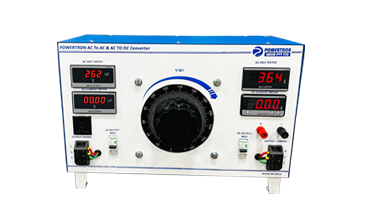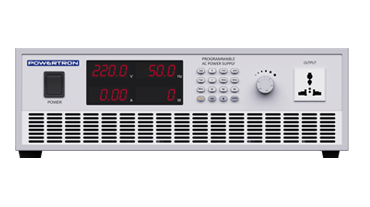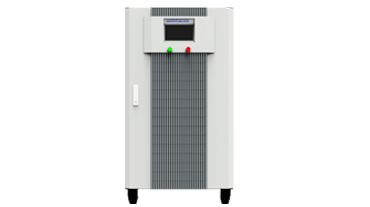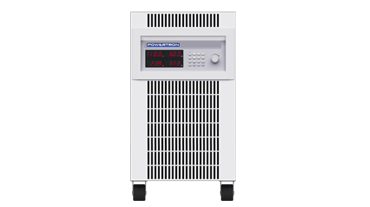

Programmable AC Power Supply Manufacturers & Exporters





Technical Specifications — Programmable AC Power Supply
| Parameter | Specification | What It Means For You |
|---|---|---|
| Rated Capacity | 500 VA, 1 kVA and 2 kVA | Bench and rack duty without over-specifying a three-phase source. |
| Input Voltage | Single phase, 220V ±10% | Runs from a standard bench outlet, tolerant of Indian supply variation. |
| Output Phase | Single phase | Matched to single-phase appliance, component and sub-assembly testing. |
| Voltage THD | Below 1% | DUT is tested against a supply cleaner than site mains. |
| Voltage Control | Programmable set point, digital entry | Repeatable conditions across operators and shifts. |
| Frequency Control | Programmable | Simulates destination-market supply for export product testing. |
| Waveform | Programmable waveform shaping | Distorted and non-sinusoidal conditions can be reproduced deliberately. |
| Current Protection | Adjustable output current limit | Trip point set to the DUT rather than to the supply rating. |
| Line Drop Compensation | Automatic cable voltage drop compensation | Programmed voltage arrives at the load end, not just at the terminals. |
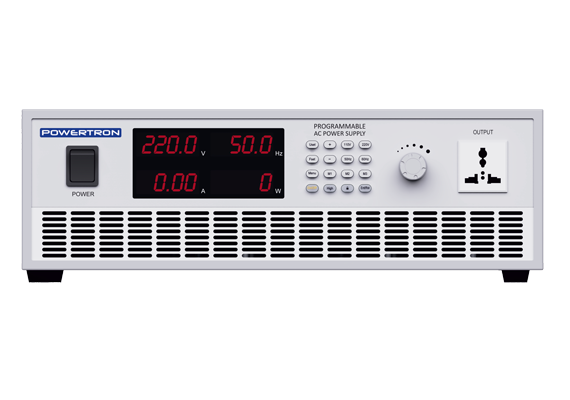
| Operator Interface | Physical buttons and knob, quick-setting recall, button lock | Fast repeat operation with protection against accidental changes. |
| Mounting | Bench top; rack format on request | Fits existing test cell layouts. |
Available Models — Programmable AC Power Supply
| Model | Input Voltage | Capacity | Typical Fit |
|---|---|---|---|
| PIPL-0K5VAP | Single phase, 220V ±10% | 500 VA | Component and small assembly testing, R&D bench |
| PIPL-1KVAP | Single phase, 220V ±10% | 1 kVA | Appliance testing, QA inspection, certification pre-checks |
| PIPL-2KVAP | Single phase, 220V ±10% | 2 kVA | Production test lines, higher-draw single-phase equipment |
| Customised | On request | Above 2 kVA | Non-standard capacity or input — quoted on application |
Which Capacity Do You Need?
| Capacity | Approx. Load at 230V | Typical Application |
|---|---|---|
| 500 VA | Up to ~2.2 A | Electronic sub-assemblies, adaptors, small controls, LED drivers |
| 1 kVA | Up to ~4.3 A | Domestic appliances, fans, small pumps, instrumentation |
| 2 kVA | Up to ~8.7 A | Heaters, larger appliances, production test stations |
| Above 2 kVA | On application | Quoted as a custom build, or move to the 3-phase programmable range |
How a Programmable AC Power Supply Works
A programmable AC power supply does not vary the incoming mains — it regenerates the AC waveform from scratch. Incoming single-phase supply is first rectified and filtered to an internal DC bus. That bus feeds a high-frequency switching inverter stage under the command of a digital controller, which synthesises the required output waveform point by point and filters the switching frequency back out. The result is an AC output whose amplitude, frequency and shape are defined entirely in software rather than being inherited from the mains.
Because the waveform is generated rather than modified, the source is independent of what the incoming supply is doing. A voltage sag on the building mains does not appear at the DUT, and the output frequency has no relationship to the 50Hz coming in. That is what allows a single unit to reproduce the supply conditions of any destination market for export product validation.
Output voltage and current are continuously sampled and fed back to the controller, which corrects the inverter drive within each switching period to hold the programmed set point. The same feedback path implements cable voltage drop compensation: the controller raises its terminal voltage by exactly the loss along the cable, so the load end sits at the programmed value. Adjustable current protection operates on the same measurement, limiting output current at the set threshold rather than at the supply rating, so a fault in the test article is caught early.
Applications of Programmable AC Power Supplies
A programmable AC source is selected when the requirement is repeatable, documented supply conditions rather than manual adjustment. That distinction decides most enquiries in this category.
| Industry | Application | What the Programmability Delivers |
|---|---|---|
| R&D Laboratories | Prototype validation across supply conditions | Exact repeatable set points logged against each test run |
| Control Panel & Automation | Panel and controller functional validation | Sag, swell and brown-out conditions reproduced on demand |
| Aerospace & Defence | Sub-system power quality qualification | Non-standard frequency and waveform conditions generated |
| Marine | Onboard equipment testing to shipboard supply conditions | Vessel supply characteristics simulated on the bench |
| Oil & Gas Refinery | Field instrument and control equipment testing | Consistent supply independent of site mains quality |
| Solar & Renewable Energy | Inverter and micro-inverter interface validation | Grid conditions simulated for anti-islanding and response checks |
| Electrical Appliance Testing | Certification and export compliance pre-testing | Destination-market voltage and frequency reproduced exactly |
| Contract Manufacturing | Production line functional test and burn-in | Identical conditions across shifts, operators and stations |
Programmable AC Power Supply vs Variac Controlled Supply
This is the most common decision a buyer faces inside the POWERTRON AC range, and the page currently gives no guidance on it. Getting this table right converts enquiries that would otherwise be lost to a competitor who explains the difference.
| Criteria | Programmable AC Power Supply | Variac Controlled AC Power Supply |
|---|---|---|
| Voltage setting | Digital, exact and repeatable | Manual rotary dial, operator-dependent |
| Frequency control | Programmable, independent of mains | None — output follows incoming mains |
| Waveform | Regenerated, THD below 1%, shapeable | Pure sine inherited from mains, not adjustable |
| Independence from mains | Complete — output regenerated from a DC bus | None — output tracks incoming supply quality |
| Sequencing | Programmable multi-step routines | Not available |
| Current protection | Adjustable trip point set to the DUT | Fixed protection on advanced models only |
| Line drop compensation | Automatic | Not available |
| Test traceability | Set points recorded and repeatable | Manual meter reading |
| Best fit | Certification, export testing, documented QA | Commissioning, bench work, manual investigation |
Manufacturing & Quality
POWERTRON INDIA PVT. LTD. designs and manufactures its complete AC power supply range at Plot No. A-426/427, Road No. 28, Wagle Estate MIDC, Thane West 400604, Maharashtra. Design, magnetics winding, PCB assembly, enclosure fabrication and final load testing are all carried out in-house, which is what allows both short lead times and genuine engineering support after the sale rather than component-level replacement only.
Every unit is tested on load across its full output envelope before dispatch, with the test record supplied against the serial number. The company holds ISO, CE and BIS certifications, is MSME registered and GeM listed, and manufactures under the Make in India framework — making POWERTRON a practical import substitute for organisations currently sourcing AC test sources from overseas. Domestic sales and service offices operate in Delhi, Pune, Hyderabad, Bangalore and Tamil Nadu, with international offices in Dubai, Singapore and Malaysia supporting export customers across the Middle East, Southeast Asia, Africa and Europe.
FAQ
The single-phase range covers 500VA, 1kVA and 2kVA, running from a 220V ±10% single-phase input. Above 2kVA, or where three-phase output is required, the 3-phase programmable AC power supply range covers 15kVA to 180kVA with customised builds beyond that.
A programmable source regenerates the AC waveform from an internal DC bus, so voltage, frequency and waveform are all set digitally and are independent of the incoming mains. A variac varies mains voltage mechanically and cannot change frequency or waveform. Use a programmable source where results must be repeatable and documented.
Yes. Voltage and frequency are both programmable, so destination-market supply conditions can be reproduced on the bench before shipment. Confirm the exact voltage and frequency range required at enquiry so the correct configuration is quoted.
On a long or heavily loaded cable run, the voltage at the load end is measurably lower than at the supply terminals. The compensation function measures that loss and raises the terminal voltage to correct for it, so the DUT actually receives the programmed voltage. Without it, every test runs slightly under-voltage.
Voltage THD is held below 1%, which is materially cleaner than typical site mains. That matters because a distorted supply can itself cause a device under test to behave abnormally, producing a test failure that has nothing to do with the product.
Yes. The output current protection threshold is adjustable, so it can be set to what the device under test can survive rather than to the full rating of the supply. On a QA bench where DUT failure is routine, this is the setting that protects the test article and the fixture.
Communication interface options should be confirmed with the POWERTRON application team for the specific model and capacity, and the unit is factory-configured to the interface specified at order.
Yes, subject to correct sizing. Inductive loads draw high inrush at switch-on and non-linear switch-mode loads draw peaky current, so both need headroom above the nominal running VA. State the load type at enquiry so the capacity is selected with the right margin.
Yes. Non-standard input voltages for export installations, extended output voltage or frequency ranges, rack-mount conversion and preloaded test sequences are all available as custom builds from the Thane facility.
Need a AC Power Supply Products?
Request a quotation for a programmable AC power supply. Send your load VA and type, required voltage and frequency range, interface and mounting format to sales@powertrondcps.com, or call +91 8097707496 / +91 7208560460. The POWERTRON team will confirm the correct capacity and quote standard or custom single-phase builds.