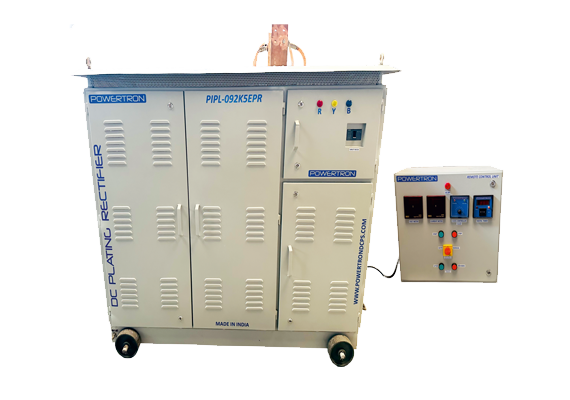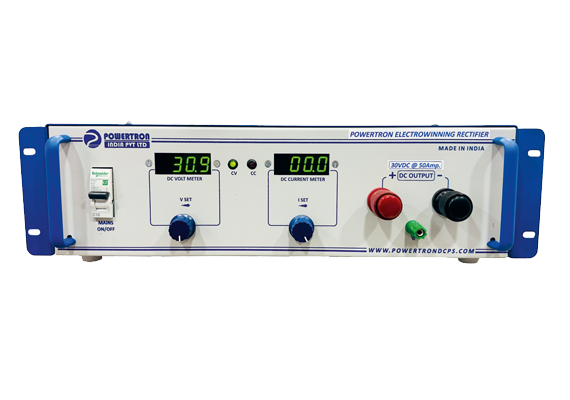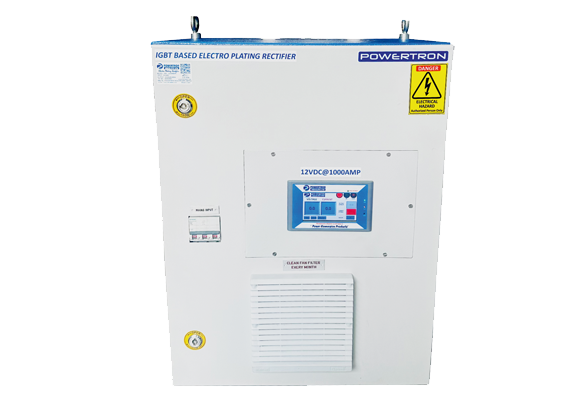

Diode Controlled Electro-Plating Rectifier Manufacturers & Exporters
Powertron's Diode Controlled Plating Rectifier delivers stable, regulated DC output using a robust diode-based rectification stage, built for electroplating, surface finishing and industrial applications where simplicity and long service life matter more than fine electronic adjustability. Output voltage runs from 0–12VDC to 0–100VDC, with current customised to load. This page covers features, specification, model options and how diode control compares to the MOSFET, IGBT and thyristor alternatives in Powertron's range.
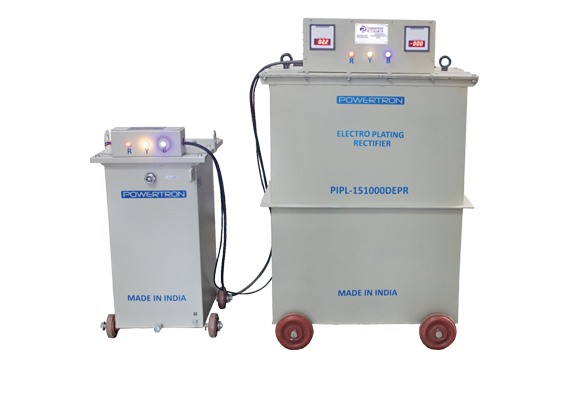





Technical Specifications — Diode Controlled Plating Rectifier
| Parameter | Specification | What It Means For You |
|---|---|---|
| Output Voltage | 0–12VDC to 0–100VDC (standard bands) | Covers small-parts plating through higher-voltage electrochemical processes. |
| Output Current | Customisable to load | Sized to bath and part throughput rather than a fixed catalogue amperage. |
| Ripple / Noise | Filtered via built-in EMI filter | Output is smoothed despite the simpler diode rectification stage. |
| Protection | Short circuit / overload / overvoltage | Bath and electrode wiring are protected under fault conditions. |
| Testing | 100% full-load burn-in before dispatch | Every unit is proven at rated current, not sample-tested, before shipment. |
| Construction | Diode-based, fewer active components | Fewer control electronics to maintain over the unit's service life — the trade-off that makes this the most straightforward option in the range. |
Model / Variant Table
| DC Output | DC Current |
|---|---|
| 0–12VDC | Customisable to load |
| 0–18VDC | Customisable to load |
| 0–24VDC | Customisable to load |
| 0–60VDC | Customisable to load |
| 0–100VDC | Customisable to load |
Range Quick-Selection Table
| Output Range Needed | Recommended Model |
|---|---|
| 0–24VDC | Simple, high-current plating where fine electronic control isn't required |
| 0–24 to 0–60VDC | General metal finishing lines standardising on a robust, low-maintenance rectifier |
| 0–60 to 0–100VDC | Higher-voltage processes prioritising reliability over adjustability |
How It Works
The Diode Controlled Plating Rectifier converts AC mains to DC using a diode bridge rectification stage — the most straightforward and mechanically robust way to produce DC power, with no active switching or phase-control electronics between input and output. A built-in EMI filter still smooths the resulting DC before it reaches the plating bath, and the protection stage monitors continuously for short circuit, overload and overvoltage conditions.
Because there are fewer active control components than in MOSFET, IGBT or thyristor designs, there is correspondingly less that can fail or drift out of calibration over years of plant-floor service — which is why this variant is positioned as the robust, low-maintenance option in Powertron's plating rectifier range, suited to processes where a simple, dependable current source matters more than fine electronic voltage/current programmability.
Applications by Industry
| Industry | Application | Load / Duty Character | Recommended Configuration |
|---|---|---|---|
| Metal Finishing | Standard electroplating baths | Continuous, high-current | 0–24 to 0–60VDC, robust duty |
| Automotive Components | Zinc, nickel plating lines | Continuous production | 0–24 to 0–60VDC |
| Aerospace & Defence | Protective plating for components | Continuous | 0–24 to 0–100VDC |
| Semiconductor | Electrochemical processing | Continuous | Low-voltage configuration |
| Power Generation | Component and busbar plating | Continuous, heavy duty | 0–60 to 0–100VDC |
| Renewable Energy | Hardware finishing | Batch/continuous | 0–24 to 0–60VDC |
Diode Controlled vs. MOSFET Controlled Plating Rectifier
| Criteria | Diode Controlled | MOSFET Controlled |
|---|---|---|
| Construction complexity | Simple, fewer active components | More electronics, higher complexity |
| Control precision | Fixed by transformer/diode design | Regulated, finely adjustable |
| Ripple performance | Filtered, adequate for most processes | Lower, best for finish-sensitive work |
| Long-term maintenance | Low — fewer components to service | Low, but more electronics to inspect |
| Relative cost | Lower upfront | Higher upfront |
| Typical best fit | Robust, high-current, less voltage-sensitive processes | Precision plating, sensitive finishes |
| Footprint for a given current rating | Larger | Compact / miniature |
Manufacturing & Quality
Every Diode Controlled Plating Rectifier is built at Powertron India's own manufacturing facility in Wagle Estate, MIDC, Thane (Maharashtra), where design, winding, assembly, and testing are carried out in-house rather than outsourced. Units go through a documented quality process before dispatch, and Powertron holds ISO, CE, BIS, and GeM empanelment credentials, with manufacturing recognised under the Make in India and MSME programmes. Beyond Thane, Powertron supports customers through sales offices in Delhi, Pune, Hyderabad, Bengaluru and Tamil Nadu, and serves export markets through international sales offices in Dubai, Singapore and Malaysia. Post-installation, the same team that engineers the unit is available for commissioning support, spares, and after-sales service, so buyers are not left dealing with a reseller once the order ships.
FAQ
It uses a simpler diode bridge rectification stage with fewer active control components, trading fine electronic adjustability for robustness and long unattended service life.
0–12VDC up to 0–100VDC in standard bands, with current customised to your load.
A built-in EMI filter smooths the output; for processes with very tight finish sensitivity to ripple, the MOSFET variant offers lower ripple performance.
Yes, each rectifier undergoes a 100% full-load burn-in test at rated current before leaving the factory.
Short circuit, overload and overvoltage protection are standard.
If your process doesn't require fine independent voltage/current programming and you're prioritising simplicity, robustness and lower upfront cost, diode control is typically the better fit.
Yes, it's well suited to robust, high-current plating processes; confirm your specific current requirement for module sizing.
Yes, output current is built to your specified load.
Metal finishing, automotive components, aerospace & defence, semiconductor, power generation and renewable energy.
Send your required output voltage and current to sales@powertrondcps.com or call the numbers listed above.
Need a Diode Controlled Plating Rectifier ?
Request a quotation for a Diode Controlled Plating Rectifier . Send your required DC output voltage and current to sales@powertrondcps.com or call +91 8097707496 / +91 7208560460 — most plating rectifier quotations are returned once load and process details are confirmed.